Manual Research vs Automated Briefings: What Wins?
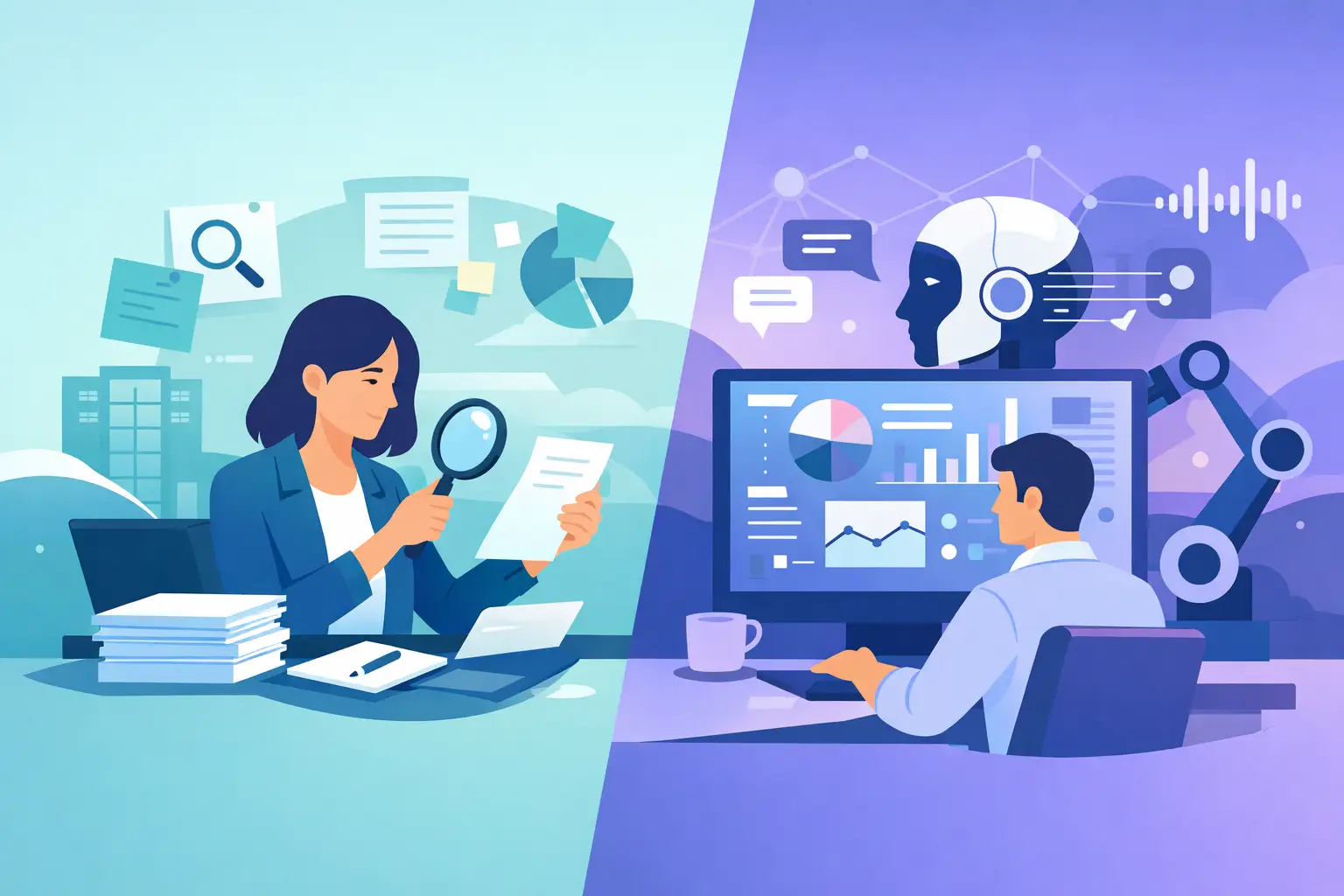
A supply chain leader can spend the first 90 minutes of a morning scanning port data, supplier alerts, earnings calls, trade reporting, and internal messages - then still miss the regulatory update that changes the week’s priorities. That is the real question behind manual research vs automated briefings: not whether information is available, but whether the right information reaches the right decision-maker in time to matter.
Manual research remains indispensable for high-stakes questions. But it is a costly default for maintaining daily situational awareness across fast-moving domains. Automated briefings can compress the monitoring burden dramatically, provided they are personalized, synthesized, and governed with the right level of human judgment.
Manual Research vs Automated Briefings: The Core Difference
Manual research is an active, analyst-led process. Someone defines a question, identifies sources, reads primary material, evaluates credibility, compares competing claims, and develops a point of view. It is designed for depth, verification, and context.
An automated briefing is a recurring intelligence process. It monitors a defined set of topics, entities, markets, risks, and interests; identifies relevant developments; prioritizes what changed; and delivers a concise update. Its job is not to replace an investigation. Its job is to ensure that material developments are seen early and framed clearly.
The distinction matters because these workflows solve different operational problems. Manual research answers, “What do we need to understand deeply before we act?” Automated briefing answers, “What changed since yesterday, and what deserves attention now?”
Treating them as substitutes leads to poor outcomes. Teams either burn senior time on repetitive monitoring or rely on automated summaries for decisions that require original-source scrutiny.
Where Manual Research Still Wins
Manual research is strongest when the question is narrow, consequential, and difficult to standardize. Consider a potential acquisition, a new market entry, a critical vendor failure, or an investment decision involving incomplete disclosures. These situations call for source validation, competing hypotheses, and judgment about what is absent as much as what is published.
A skilled researcher can interrogate an assertion rather than simply report it. They can notice that a company’s language changed between two filings, trace an operational claim to a weak source, or recognize that a headline conflicts with on-the-ground incentives. That work requires expertise and a clear decision frame.
Manual work also performs better when the source universe is obscure or unstable. A domain specialist may know which regional trade publication consistently breaks accurate news, which analyst is prone to exaggeration, or which government database lags reality. Those distinctions are hard to encode completely.
The trade-off is capacity. High-quality research takes time, and time is finite. When an executive, analyst, or operator is manually checking the same 30 sources every day, the organization is paying expert attention for a task that is often repetitive. The cost is not only labor. It is the strategic work that never gets done because monitoring consumed the available hours.
Where Automated Briefings Create an Edge
Automation is most valuable when the environment moves faster than any one person can monitor. Technology leaders tracking model releases, policy moves, security incidents, customer signals, and competitors do not need more tabs open. They need a reliable view of what changed and why it may affect their operating plan.
A well-designed briefing turns broad surveillance into a focused daily decision aid. It can monitor hundreds of relevant sources, surface developments aligned to a subscriber’s role and priorities, and reduce low-value repetition. That creates two advantages: coverage and consistency.
Coverage means fewer blind spots. Important signals often emerge outside the sources a person checks habitually. Consistency means that monitoring does not disappear during travel, a product launch, an earnings cycle, or a week of back-to-back meetings.
The quality standard is higher than aggregation. A feed that simply delivers more links shifts the burden back to the reader. An intelligence briefing should synthesize the development, identify the implication, and make the priority legible. The reader should be able to distinguish between a notable event, a material risk, and background noise in minutes.
For example, an investor following industrial AI may not need ten separate articles about a factory software partnership. They need to know whether the partnership changes adoption velocity, competitive positioning, capital requirements, or the assumptions behind a portfolio thesis.
The Failure Modes of Both Approaches
Manual research fails quietly through inconsistency. People skip scans when workload rises. They gravitate toward familiar sources and reinforce existing views. They may read extensively without recording what mattered, leaving valuable context stranded in browsers, inboxes, and individual memory.
Automated briefings fail when they are generic, poorly scoped, or trusted beyond their design limits. A general business newsletter cannot understand that a CTO needs semiconductor supply constraints, a commodities operator needs export policy shifts, and a strategy lead needs competitor pricing changes. Relevance must be built into the briefing profile.
Automation can also amplify weak inputs. If the source set is low quality, the output will be low quality at scale. If an automated system flattens uncertainty into confident language, it can create a dangerous illusion of clarity. Good intelligence preserves distinctions between confirmed facts, credible reports, emerging signals, and interpretation.
This is why source transparency, careful prioritization, and a human escalation path matter. A briefing should tell you what merits investigation, not persuade you to stop thinking.
Build a Two-Speed Intelligence System
The strongest operating model combines automated monitoring with deliberate human research. Automation handles the persistent, broad, and repetitive work. Human expertise handles the ambiguous, high-impact, and decision-specific work.
Start by defining the questions your daily intelligence system must answer. For an operating executive, those may include: What could disrupt delivery? Which competitor action changes our position? What external shift affects costs, demand, or regulation? What decision needs attention this week?
Then define the signal categories that support those questions. Categories might include competitors, customers, suppliers, regulations, capital markets, technology, geopolitical exposure, and key internal initiatives. The goal is not maximum coverage. It is useful coverage tied to actual responsibilities.
Next, establish escalation rules. A routine product update may remain in the daily briefing. A credible report of a supplier shutdown, a major security vulnerability, or a policy proposal affecting a core market should trigger deeper review. This separates awareness from analysis and prevents every item from receiving the same amount of attention.
Finally, capture what the organization learns. A searchable archive turns daily updates into more than a transient email. Over time, it provides a record of how a narrative developed, when a risk first appeared, what assumptions held, and where prior decisions were made. That is institutional memory with operational value.
What to Measure Beyond Time Saved
Time saved is the obvious metric, but it is incomplete. A briefing process that saves an hour while omitting the one event that changes a decision is not efficient. Measure signal quality alongside speed.
Useful indicators include the percentage of briefings that identify an item requiring action, the number of important developments discovered before they become widely obvious, and the reduction in duplicated scanning across a team. Also examine false positives. If readers routinely ignore most items, the system needs sharper personalization or better prioritization.
The right benchmark is decision readiness. After reading the briefing, can the recipient explain what changed, why it matters, and whether someone needs to investigate, decide, or act? If not, the output may be informative but it is not yet intelligence.
The Decision Is Not Manual or Automated
The choice is rarely binary. A founder preparing for a board meeting may spend hours on manual analysis while relying on automation to monitor customer, market, and competitor developments. A research analyst may use a daily briefing to spot emerging themes, then shift into primary-source work for a thesis-changing event.
BriefingIQ is designed for this division of labor: personalized daily intelligence that reduces monitoring overhead while keeping the reader focused on the developments most relevant to their role and priorities.
The best workflow gives human attention its proper job. Do not spend it collecting routine updates. Spend it testing assumptions, interpreting trade-offs, and making the decisions that move the business.