How to Prioritize Supply Chain Disruptions
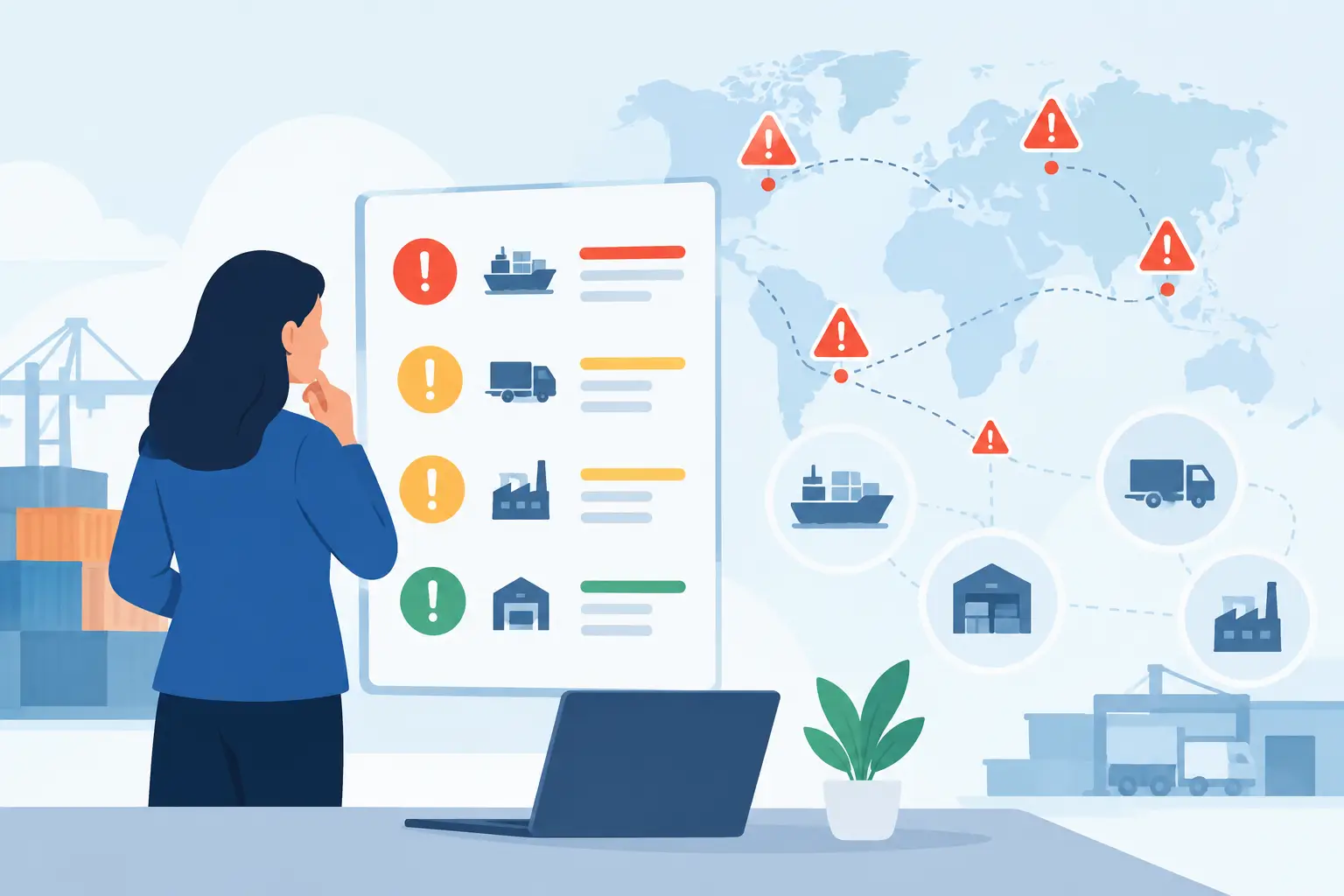
A port delay, a supplier quality failure, and a carrier capacity shortfall can arrive in the same morning. Treating all three as equally urgent is how teams burn time, escalate noise, and still miss the disruption that puts a key customer at risk. To prioritize supply chain disruptions, operators need a common decision frame that distinguishes visible problems from material business threats.
The objective is not to eliminate every exception. That is neither practical nor necessary. The objective is to identify which disruptions require executive attention, which need a defined operating response, and which can remain under watch with clear thresholds for escalation.
Prioritize supply chain disruptions by business exposure
The loudest issue is rarely the most consequential one. A late container can prompt a dozen emails while a small component shortage quietly stops production of a high-margin product line three weeks later. Prioritization starts with exposure, not volume of internal activity.
Assess each disruption across four dimensions: customer impact, financial impact, time to consequence, and recovery difficulty. Together, they provide a more useful picture than a simple red-yellow-green status flag.
Customer impact asks who will feel the failure and how severely. A missed replenishment date for a low-volume customer may be manageable. A shortage that interrupts a contractual service level, a launch, or a strategic account is different. Consider revenue at risk, the availability of substitutes, and the customer relationship at stake.
Financial impact includes more than lost sales. Include expedite costs, line downtime, write-offs, penalties, excess inventory created elsewhere, and working-capital pressure. A disruption with a modest revenue effect can still deserve priority if the recovery path requires expensive air freight or forces a production schedule change.
Time to consequence measures the remaining decision window. An issue that will affect output tomorrow deserves attention even if the total financial exposure is lower than a problem forecast for next quarter. Conversely, an early warning with a long lead time may be highly significant without being an immediate escalation.
Recovery difficulty is the factor teams often underweight. Can supply be shifted between plants? Is there a qualified alternate supplier? Can the product be redesigned, allocated, or substituted? A disruption with limited recovery options should rise in priority well before it becomes a customer failure.
Use a triage model that leads to action
A useful triage model must produce a decision, not just a score. One practical approach is to assign disruptions to three operating categories: act now, manage actively, and monitor.
Act now: material exposure within a short window
Put an issue in the act-now category when it threatens a critical customer, production continuity, compliance obligation, or significant cash exposure within the next days or weeks. The exact window depends on the business. A semiconductor manufacturer may need months of lead time; a grocery distributor may have hours.
The response should have a named owner, a decision deadline, and a specific objective. For example: secure 10 days of coverage for a constrained component, preserve service to the top 20 accounts, or determine whether to activate a preapproved alternate source. Avoid assigning vague tasks such as "monitor supplier situation." Monitoring is not a recovery plan.
Manage actively: exposure exists, but options remain
These disruptions need disciplined tracking and regular operating review. The business impact may be material, but there is enough time to compare scenarios, test alternatives, and make controlled trade-offs.
An actively managed issue may involve a supplier operating below plan, a likely trade-policy change, or freight congestion building in a specific lane. The right response might be to adjust reorder points, reserve capacity, confirm supplier inventory, or prepare customer allocation rules. The core requirement is to define the trigger that moves the issue into act-now status.
Monitor: a credible signal without a current operating consequence
Monitoring does not mean ignoring. It means documenting the signal, assigning a review cadence, and resisting the impulse to mobilize resources before a threshold is crossed. Examples include regional weather risk, early labor negotiation reports, or a supplier's financial deterioration before delivery performance changes.
This category protects the organization from alert fatigue. It also creates an institutional record of what was known and when, which improves post-incident review and future planning.
Separate incident facts from assumptions
Supply chain teams often make decisions under incomplete information. That cannot be avoided. What can be avoided is presenting assumptions with the certainty of verified facts.
Every disruption briefing should distinguish among confirmed facts, informed estimates, and unknowns. Confirmed facts might include an affected facility, a delayed vessel, current inventory, and open purchase orders. Estimates may cover duration, recovery dates, and supplier allocation risk. Unknowns may include whether a disruption will spread to a second site or whether a carrier can honor replacement capacity.
This distinction changes the quality of escalation. Executives can accept uncertainty when they understand its boundaries. They cannot make sound allocation, procurement, or customer commitments from a blended narrative where confidence levels are unclear.
A short daily briefing works well here: state what changed, quantify the exposure, explain why it matters, and identify the decision required. If no decision is required, say so. That restraint builds trust.
Make customer and product allocation explicit
When supply is constrained, organizations often default to first-in, first-out allocation. That may be operationally easy, but it is not necessarily commercially sound. Priority should reflect the consequences of a missed shipment, not merely the order in which demand entered the system.
Define allocation principles before the shortage becomes acute. Factors can include contractual commitments, customer criticality, margin, strategic product launches, public safety needs, and the availability of substitutes. There will be trade-offs. Protecting a strategic account may mean delaying a smaller account. Reserving constrained parts for high-margin products may reduce total unit volume.
The point is not that one rule fits every business. The point is that operators should not negotiate the rules from scratch during every disruption. Predefined principles speed decisions and reduce internal conflict.
Watch for second-order effects
A disruption rarely remains isolated. Expedite decisions can raise freight expense. Production resequencing can create inventory imbalances. Supplier allocation can force demand to another site that lacks labor or warehouse capacity. A response that solves today's shortage may create next month's margin or service problem.
For high-priority incidents, require a second-order check before approving the response. Ask three questions: What constraint does this action move elsewhere? What cost does it create? What signal would tell us the response is no longer working?
This is especially important when teams use buffers. Raising inventory may reduce immediate stockout risk, but it can also consume cash and warehouse space. Dual sourcing can improve resilience, yet it may increase qualification work, unit cost, and supplier-management complexity. Resilience has a price. The right decision depends on the cost of failure for the item, customer, and network involved.
Build the intelligence rhythm before the next disruption
The quality of disruption prioritization depends on the quality of the underlying signals. Operators need visibility across supplier performance, inventory coverage, production constraints, logistics conditions, demand changes, policy developments, and financial health. But more data does not automatically create better judgment.
Create a standing disruption briefing that focuses on changes against defined thresholds. Include the affected node, the exposure, confidence level, response owner, next decision date, and unresolved dependencies. Keep the format consistent enough that leaders can scan it quickly and compare issues over time.
A tailored intelligence workflow can support this discipline by synthesizing external developments alongside the operator's stated priorities, rather than leaving teams to assemble fragmented updates manually. BriefingIQ is designed around that daily decision need: what changed, why it matters, and where attention should go next.
The most useful supply chain briefing is not the one with the most alerts. It is the one that makes the next decision easier. Set your thresholds before the next incident, name the trade-offs you are willing to make, and let the team spend its attention where recovery options are shrinking.